Exactly What He Owed
Rúḥíyyih Khánum, The Priceless Pearl
When in Bahá'í history
How this story reached us
- 1.The Priceless Pearl, ch. 1, pp. 21-24 (narr/wrapped/khanum_priceless_pearl.txt lines 507-532: the Master's return to Egypt on 16 June 1913, Shoghi Effendi's arrival at Ramleh on 1 August, his services there, "the Master was like an ocean"; lines 543-566: the two stories Shoghi Effendi told of Egypt, including the Baghdád days after Sulaymáníyyih; the coachman at Ramleh)
- 2.The Priceless Pearl, ch. 6, pp. 130-131 (same file lines 3155-3181: the Sydney and Kampala Temples, saving the money of the Faith; economy, debts before pilgrimage, adding up every bill, overcharges and undercharges, refusing to overpay; the car sold during the war)
- 3.The Priceless Pearl, ch. 11, p. 245 (same file lines 5955-5960: the Shrine contractors; "no one could either mislead or cheat Shoghi Effendi"; "I was his sword!")
A retelling based on The Priceless Pearl by Rúḥíyyih Khánum. Words in quotation marks are quoted from that book.
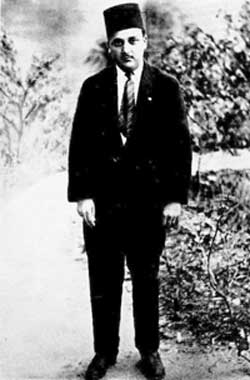
'Abdu'l-Bahá returned to Egypt from His long journey to the West on 16 June 1913, sixty-nine years old and exhausted from His labours. His grandson Shoghi Effendi, then sixteen and a student in Beirut, arrived on 1 August in the company of the Greatest Holy Leaf at Ramleh, where the Master had once again rented a villa. During the months he was with Him, Shoghi Effendi made himself constantly useful, taking down His letters to the Persian believers as He dictated them in the garden, waiting on Him, doing errands for Him, and meeting visitors at the railway station.
Shoghi Effendi told his wife, Rúḥíyyih Khánum, two stories of the days he had spent in Egypt with his grandfather, 'Abdu'l-Bahá. One was gentle. After an especially rich meal the Master had remembered the days in Baghdád when the family had been so poor, after Bahá'u'lláh returned from the mountains of Sulaymáníyyih, the days when from His pen had streamed "such a torrent of exalted writings," and the believers gathered night after night until dawn to hear them chanted. He said that the dry bread and dates of that time had tasted sweeter than all the other food in the world.
The other story, she wrote, "surprised me - and enlightened me - very much." She heard it from him more than once.
One day the Master drove back from Alexandria to Ramleh in a rented carriage, with the boy Shoghi Effendi and a Pasha who was coming to the house as His guest. When they arrived and got out, 'Abdu'l-Bahá asked the coachman, a big, strapping man, how much He owed him. The man named an exorbitant price.
'Abdu'l-Bahá refused to pay it. The coachman insisted and became abusive. At last he took hold of the Master by the sash around His waist and pulled Him roughly back and forth, still demanding his price.
Shoghi Effendi said that this scene, in front of the distinguished guest, embarrassed him terribly. He was too small to do anything to help, and he felt horrified and humiliated. "Not so 'Abdu'l-Bahá, Who remained perfectly calm and refused to give in."
When the man finally let go, the Master paid him exactly what He owed him. He told the coachman that his conduct had forfeited the good tip He had planned to give him, and walked off, with Shoghi Effendi and the Pasha following. Many times, his wife recalled, Shoghi Effendi would say "the Master was like an ocean," meaning that He could receive everything and give forth no sign of disturbance.
Rúḥíyyih Khánum had no doubt that such things left a lifelong imprint on the Guardian, who "never allowed himself to be browbeaten or cheated, no matter whether or not this embarrassed or inconvenienced him."
She saw it in the way he handled money. "I never saw the Guardian settle a bill he had not first carefully added up," she wrote, "whether it was for a meal or a payment of thousands of dollars! If there was an overcharge he pointed it out - and also if there was an undercharge." Many times, she says, she went to astonished people and told them that their addition was wrong and they should do it again, or they would be the losers.
Economy was a very rigid principle with him. He was a determined bargainer. More than once, when an ornament for the Shrines, the Archives or the gardens was beautiful but too expensive, and the seller would not meet his price, he did not buy it, even though he wanted it and had the money. "He just considered it wrong and would not do it." More than once he refused to let someone he knew to be in debt make the pilgrimage, saying he must first pay his debts. During the worst years of the Second World War, when spare parts could not be had for his car, he sold it and used taxis. Another car could no doubt have been bought, she wrote, "but it never entered his mind."
For two of the three Continental Houses of Worship of the Ten Year Plan, at Sydney and Kampala, local architectural firms at first made expensive suggestions. Shoghi Effendi modified these himself, so that both Temples were built within what he considered a reasonable price for the Cause to pay. "Over and over his shrewdness and sound judgment saved the money of the Faith so that it could be spent on the many all-important tasks."
While the superstructure of the Shrine of the Báb was being built on Mount Carmel, Rúḥíyyih Khánum represented him in the negotiations with the supervising engineer and the contractor. They were often difficult, she wrote, "as no one could either mislead or cheat Shoghi Effendi." When an estimate was too high he refused it flatly, and on one occasion he said he would stop work on the Shrine indefinitely rather than pay what he felt was an exorbitant price. "He battled his way through every obstacle," she wrote, "and I often found, to my great surprise, that I was his sword!"
This is a retelling. For the fuller account, see The Priceless Pearl by Rúḥíyyih Khánum.
Record yourself reading this story
Recording stays on this device only. Nothing is uploaded.
Related stories
The Cable in London
In November 1921 Shoghi Effendi, a student at Oxford, learned from a cable in a London office that 'Abdu'l-Bahá had passed away; back in Haifa, the Master's Will told him he had been appointed Guardian.
The Master and the Coachman
Shoghi Effendi told how a coachman at Ramleh demanded an exorbitant fare from ‘Abdu’l-Bahá and pulled Him roughly by His sash. The Master stayed calm, refused to give in, and paid exactly what He owed, without the tip.
The Car Delivered at Once
When a car given to ‘Abdu’l-Bahá reached port as a weekend began, Shoghi Effendi went to officials' homes for their signatures and had it at the Master's door though it was not a business day.
Shoghi Effendi as a Boy
Rúḥíyyih Khánum recalls that the Guardian as a small boy was the high-spirited ringleader of the children, and that ‘Abdu’l-Bahá once wrote a short sentence about how much he ran about.