Leroy Ioas Remembers the Guardian
bahaistories.com archive · Read original
When in Bahá'í history
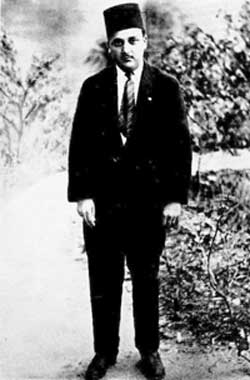
When I first arrived in the Holy Land, there were two or three things about the Guardian that impressed me very much. And one was, particularly, the size of the Guardian. Now in the West, for you people who haven’t been in the West, we’ve come to associate the idea of majesty and greatness with size. The man had to be a great man, had to be a big man, six feet tall, big shoulders, and so on. Shoghi Effendi was a very refined man. He was small in stature. He was so refined and delicate. His features, his nose, his eyes, his hands, every one of his features was so delicate, so refined, and so perfect that you could realize that the power when he spoke was not of the man, Shoghi Effendi, but was the power of the Spirit coming through him. He was a channel that God used. He was not just a man sitting there. I used to sit and marvel, the Guardian, so refined, so delicate, so beautiful, and yet the power with which he spoke! And when he would speak about the power of the Cause of God the building was shaking, the whole thing was shaking. It was a tremendous experience to see how God could use a chosen instrument to speak through, and to work through, and to disseminate His Will and His Power throughout the world.
Shoghi Effendi was about the size or smaller than ‘Abdu’l-Bahá. You’ve all seen pictures of ‘Abdu’l-Bahá. Shoghi Effendi was smaller than ‘Abdu’l-Bahá. He looked quite a bit like ‘Abdu’l-Bahá, and he walked like the Master; he had the same stance as the Master. One time I was walking along the top of the Shrine of the Báb, (we were building the Shrine) and I looked down, and the Guardian was coming into the garden and the sun was shining on him, and as I looked down, I said, “Good gracious, there is ‘Abdu’l-Bahá.” And then I looked down again, of course, it was the Guardian. But if he had had a white beard on him, I would have sworn it was the Master, because it was the same walk, the same stance, the same look.
He had the same features in his face, generally, as ‘Abdu’l-Bahá, which means he had quite a few of the same features as Bahá’u’lláh. When you see the pictures of ‘Abdu’l-Bahá, you’ll see some of those features. The construction of the eyes was like the Báb. You know that he was a descendant of both Bahá’u’lláh and of [the family of] the Báb.
And his hands, most delicate and graceful hands, the fact of the matter is that when he was a child, the Greatest Holy Leaf, who was ‘Abdu’l-Bahá’s sister, and who we look upon as the most holy and most perfect woman in the Bahá’í world, the Greatest Holy Leaf used to hold him in her lap and hold his hands and she’d say, these are the hands of Bahá’u’lláh. The Guardian was always a very serious, and yet a very delightful character. Even when he was small, he showed his signs of power and greatness. And ‘Abdu’l-Bahá used to insist that everyone called him Shoghi Effendi. They were never allowed to call him Shoghi, like you do with children, using just his first name, but He insisted that they use his title of Effendi, Shoghi Effendi. Even his father and mother had to call him Shoghi Effendi. And ‘Abdu’l-Bahá used to call him Shoghi Effendi. And always, they used to say, He would pat him on the head and call him His little House of Justice, to show that even from childhood, ‘Abdu’l-Bahá had indicated that he would be the successor to ‘Abdu’l-Bahá and would become the head of the Faith.
Source: Leroy Ioas, "In the Days of the Guardian", a talk given in Johannesburg, South Africa, 1958 (transcript at bahai-library.com).
Collected from bahaistories.com (Subject: shoghi-effendi).
Cite this story
Various. *bahaistories.com archive*. https://bahaistories.com/subject/shoghi-effendi
Record yourself reading this story
Recording stays on this device only. Nothing is uploaded.
Related stories
The Key of the Holy Tomb
It is not unknown to those who stand firm in the Covenant and Testament of God that the centre of violation and his associates, from the day of the ascension of the Ancient Beauty, may His Great Name be ever exalted …
The Guardian Conquers Himself
Leroy Ioas recalled Shoghi Effendi telling how, unwilling to become Guardian after ‘Abdu’l-Bahá’s passing, he went to the mountains of Switzerland and fought with himself until he conquered himself, and that every Bahá’í must do the same.
Stricken with Grief and Pain
This servant, after that grievous event and great calamity, the ascension of His Holiness ‘Abdu’l-Bahá to the Abhá Kingdom …
He Has Not Left Us Without a Leader
We thank you most sincerely for your kind letters of sympathy, and we appreciate your loving Messages, which are as comforting balm to our wounded hearts.