The Three Uncles of the Báb
Bahá'í Chronicles editors, Bahá'í Chronicles · Read original
When in Bahá'í history
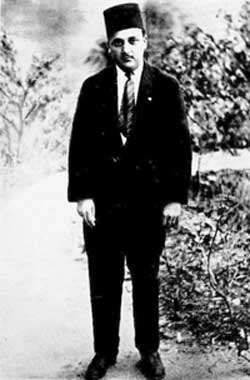
A retelling for children of the account of the three uncles of the Báb in Bahá'í Chronicles, which draws on Nabíl's The Dawn-Breakers, with details from H. M. Balyuzi's Bahá'u'lláh, The King of Glory and Adib Taherzadeh's The Revelation of Bahá'u'lláh, volume 1.
The Báb's mother had three brothers: Ḥájí Mírzá Siyyid 'Alí, Ḥájí Mírzá Siyyid Muḥammad and Ḥájí Mírzá Ḥasan-'Alí. Each of them came to believe in the Báb, but at different times.
The uncle who raised Him
When the Báb's father died, the Báb was still a child, and Ḥájí Mírzá Siyyid 'Alí, a leading merchant of Shíráz, took Him into his care.
It was Quddús, one of the Letters of the Living, who taught this uncle about the new Faith. After the Letters of the Living, he was the first person in Shíráz to accept it.
When the Báb came back from His pilgrimage to Mecca and was arrested in Shíráz, His uncle gave his word in writing that he would be responsible for Him. Later, when the Báb was a prisoner in the castle of Chihríq, far away in the north-west of Persia, His uncle travelled there to visit Him.
From Chihríq the uncle went to Ṭihrán. In 1850 he was arrested there with other believers. Wealthy merchants offered to pay for his release, and the Grand Vizier told him that one word denying the Báb would set him free. He refused. "I only request of you that you allow me to be the first to lay down my life in the path of my beloved Kinsman," he said. He was the first of the Seven Martyrs of Ṭihrán.
The uncle who asked questions
Ḥájí Mírzá Siyyid Muḥammad had once traded alongside the Báb in the port of Búshihr. During the six years of the Báb's ministry he stood by his Nephew and defended Him, but he did not become His follower.
In 1862 he and his younger brother, Ḥájí Mírzá Ḥasan-'Alí, went to visit the holy shrines of 'Iráq. Bahá'u'lláh, Who was then living in Baghdad, invited them to meet Him, and Ḥájí Mírzá Siyyid Muḥammad came. Bahá'u'lláh asked him what was keeping him from accepting the Báb. He said he had some questions that troubled him, and Bahá'u'lláh told him to write them down.
The next day the uncle brought his questions. Within two days and two nights, Bahá'u'lláh revealed His answer: the Kitáb-i-Íqán, the Book of Certitude. After reading it, the uncle recognized the station of the Báb.
The first copy of the book, written out by 'Abdu'l-Bahá with additions in the margins by Bahá'u'lláh Himself, stayed in the uncle's family. Many years later his great-granddaughter, Fáṭimih Khánum Afnán, gave it to Shoghi Effendi, the Guardian of the Faith. It is now kept in the International Bahá'í Archives on Mount Carmel.
The youngest uncle
Ḥájí Mírzá Ḥasan-'Alí had travelled to 'Iráq with his brother, but he did not go with him to meet Bahá'u'lláh. He went home to Yazd. Some years later, through the efforts of his wife's brother, he too accepted the Faith, and he remained firm in it for the rest of his life.
This is a retelling for children. For the fuller account, see "Haji Mirza Siyyid Ali, Haji Mirza Siyyid Muhammad and Haji Mirza Hassan Ali".
Cite this story
editors, B. C.. *Bahá'í Chronicles*. https://bahaichronicles.org/haji-mirza-siyyid-ali-haji-mirza-siyyid-muhammad-and-haji-mirza-hassan-ali/
Record yourself reading this story
Recording stays on this device only. Nothing is uploaded.
Related stories
The Three Uncles of the Báb
The Báb’s three maternal uncles took different paths: Ḥájí Mírzá Siyyid ‘Alí raised Him and died one of the Seven Martyrs of Tehran; Ḥájí Mírzá Siyyid Muḥammad received the Kitáb-i-Íqán; the youngest believed some years later.
The Life of Táhirih
‘Abdu’l-Bahá’s memorial of Táhirih: the learned woman of Qazvín who recognized the Báb, taught boldly in Karbilá and Baghdád, appeared unveiled at Badasht, and was put to death in Tihrán.
The King and the Beloved of Martyrs
As boys, two brothers of Isfahan served the Báb at their father's banquet. Grown into honest, generous merchants, they were put to death in 1879, and Bahá’u’lláh named them the King of Martyrs and the Beloved of Martyrs.
Mullá Ḥusayn and the Black Standard
In July 1848, at the Báb's bidding, Mullá Ḥusayn left Mashhad wearing the Báb's green turban, with the Black Standard carried before him, and led his companions to the shrine of Shaykh Ṭabarsí in Mázindarán.