The General Who Held His Arm
Lady Blomfield, The Chosen Highway, (1940)
When in Bahá'í history
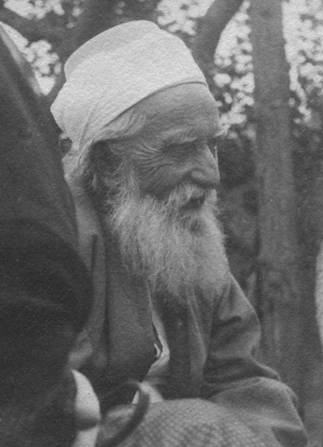
How this story reached us
- 1.The Chosen Highway, Part III, ch. IV, 'Abdu'l-Bahá in War-time, section "The Story of Mirza Jalal Isfahani, Son-in-Law of 'Abdu'l-Bahá" (narr/wrapped/chosen.txt lines 3127-3197)
A retelling based on The Chosen Highway by Lady Blomfield, which gives the account of a member of 'Abdu'l-Bahá's family who travelled with Him, translated from the Persian. Words in quotation marks are quoted from that account.
At about seven o'clock one morning early in 1916, during the war, 'Abdu'l-Bahá sent His son-in-law for His coachman. "Tell Isfandiyar to have my carriage brought, and you and Khusraw be ready to accompany me to Nazareth in half an hour." Within the half-hour they had left His house in Haifa.
The Master was not well that day, and His face showed signs of weariness. But Jamál Páshá, the Commander-in-chief of the Syrian and Palestine fronts, was in Nazareth, and 'Abdu'l-Bahá was determined to meet him. Because of false accusations, Jamál Páshá had been His great enemy. So "in spite of His great fatigue and physical weakness" He set out.
At one in the afternoon they reached a small village called Majdal. "Have you any acquaintance in this village?" the Master asked. His son-in-law knew the headman, a Christian named Khuri, and went ahead to ask for shelter and time to rest. The headman and many of the village notables came running to the carriage and helped 'Abdu'l-Bahá down with great respect. Khusraw made tea and set out the food they had brought from Haifa, and the host added honey, yoghourt, olives and eggs. The Master took only a few spoonfuls of honey, a little broth and some olives, and then slept for about an hour.
Afterwards He sat with the host and the notables and advised them on the difficulties the war had brought them. The headman thanked Him and said he had one more request.
"What is your request?" said 'Abdu'l-Bahá. "It will be a happiness to grant it if I have the power."
The headman's only child, a girl of fourteen, had been consumptive for two years, and all the physicians had pronounced her a hopeless case. He asked the Master to pray for her, and then burst into tears.
'Abdu'l-Bahá rose at once. "Where is your little girl?"
She lay on a bed on the floor of the next room, with her family around her. He sat down at the head of the bed and felt her pulse. Her fever was very high, and she coughed continually. He laid His hand on her forehead and asked for a cup of tea. He drank a little of it and prayed for about five minutes. Then with a spoon He slowly gave her the rest of the tea, twice placed His hands on her forehead, and prayed again for about ten minutes.
Then He stood and said to the parents, in a loud voice of command: "Be assured God will grant a complete cure to your daughter. Do not be perturbed, and neither weep nor moan. With utmost assurance nurse her. Before long she will be in perfect health."
He stayed another half-hour with the people in the guest room and then went out to the carriage. Men, women and children of the village crowded around it, asking for His prayers until He left.
That night the girl perspired heavily and her fever began to fall. According to her father, within two months she was completely well. In 1922 she married a government official of 'Akká, and at the time the account was written she was the mother of three healthy children. Her father told the story many times in 'Akká, Haifa and Nazareth, and always ended it: "My daughter was given back to me by His Holiness 'Abbas Effendi."
'Abdu'l-Bahá reached Nazareth at seven that evening and stayed at the German Hotel. The next day He was invited to lunch at the house of a notable of the town, of the Fahum family. Jamál Páshá was there with nearly two hundred of the war leaders. They sat down at one o'clock and rose at four. All that time 'Abdu'l-Bahá spoke in Turkish on philosophy, science and heavenly teachings, and His listeners stopped eating to hear Him. "Who is this great and learned Shaykh who is so well-informed in science?" they asked.
Jamál Páshá had not paid 'Abdu'l-Bahá proper respect when He arrived. Now he was most deferential. When the Master rose from the table, the general took His arm to help Him, led the way to the reception room himself and seated Him there. When the Master left, Jamál Páshá, a man "not accustomed to rise from his seat to pay respect to anyone", went with Him to the bottom of the steps and would have gone further if 'Abdu'l-Bahá had not thanked him and urged him to go back.
'Abdu'l-Bahá was very tired and spent another night at the German Hotel. The account ends: "The next day, His work of making a friend of an old enemy having been accomplished, He returned to Haifa."
H. M. Balyuzi, who quotes this account in 'Abdu'l-Bahá: The Centre of the Covenant, adds that in time the insinuations of His opponents had their effect, and Jamál Páshá declared that he would crucify 'Abdu'l-Bahá when he returned victorious from his campaigns. When he did come back he was in full flight, defeated, and could not stop to carry out his threat.
This is a retelling. For the fuller account, see The Chosen Highway by Lady Blomfield (chapter "'Abdu'l-Bahá in War-time"), and H. M. Balyuzi, 'Abdu'l-Bahá: The Centre of the Covenant.
Record yourself reading this story
Recording stays on this device only. Nothing is uploaded.
Related stories
'Abdu'l-Bahá and Jamál Páshá
In the First World War the Ottoman commander Jamál Páshá, turned against 'Abdu'l-Bahá by false accusations, threatened to crucify Him. The threat was never carried out: the general's campaigns failed and he fled in defeat.
Refuge at Abú-Sinán
When war came in 1914, ‘Abdu’l-Bahá moved the Bahá’ís of Haifa to the Druze village of Abú-Sinán, where vegetables He had taught them to grow and corn from ‘Adasíyyih kept many from hunger.
A Visit to Charles Tinsley
In October 1912 ‘Abdu’l-Bahá visited Charles Tinsley, a Black believer in San Francisco confined to bed with a broken leg, and told him a parable of a ruler who trained through hardship the subject he loved.
Caring for the Sick
‘Abdu’l-Bahá visited the sick, sent daily to ask after them, and quietly paid a doctor to care for the poor of ‘Akká. When a poor, crippled woman with measles was shunned, He arranged her care and, at the last, her funeral.