The Guardian's Letter to the United Nations
Rúhíyyih Khánum, The Priceless Pearl, (1969)
When in Bahá'í history
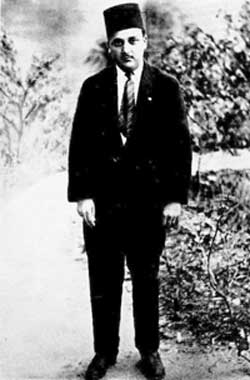
How this story reached us
- 1.The Priceless Pearl, pp. 286-289 (narr/khanum_priceless_pearl.txt; lines 4757-4798 of the 160-column fold at scratchpad/fold/khanum_priceless_pearl.txt: Justice Sandström's letter of 9 July 1947, Shoghi Effendi's reply of 14 July 1947 quoted in full, and Rúhíyyih Khánum's comment on it)
A retelling based on The Priceless Pearl by Rúhíyyih Khánum. Words in quotation marks are preserved in that account.
As the British Mandate drew to its close, and, in Rúhíyyih Khánum's words, "the troubled people of Palestine were preparing to fight it out," the United Nations appointed a Special Committee on Palestine, headed by Justice Emil Sandström. On 9 July 1947 he wrote to Shoghi Effendi from Jerusalem. The committee's terms of reference, he explained, charged it with giving most careful consideration to the religious interests in Palestine of Islam, Judaism and Christianity. He went on: "I should appreciate it if you would advise me whether you wish to submit evidence - in a written statement on the religious interests of your Community in Palestine."
Shoghi Effendi replied on 14 July. Rúhíyyih Khánum quotes the reply in full in her biography of him, "because of the historic importance to Bahá'ís" of what he wrote.
He thanked the chairman for "the opportunity of presenting to you and your esteemed colleagues a statement of the relationship which the Bahá'í Faith has to Palestine and our attitude towards any future changes in the status of this sacred and much disputed land." He enclosed a brief sketch of the history, aims and significance of the Faith, and a small pamphlet setting out its views on the present state of the world.
"The position of the Bahá'ís in this country is in a certain measure unique," he wrote. Jerusalem is the spiritual centre of Christendom, but not the administrative centre of any Christian church. The holy sites of Islam and the centre of its pilgrimage are in Arabia. The Jews alone offered somewhat of a parallel. "But even their case differs in one respect from that of the Bahá'ís, for it is in the soil of Palestine that the three central Figures of our religion are buried, and it is not only the center of Bahá'í pilgrimages from all over the world but also the permanent seat of our Administrative Order, of which I have the honor to be the Head."
Then he set out the Faith's position:
"The Bahá'í Faith is entirely non-political and we neither take sides in the present tragic dispute going on over the future of the Holy Land and its peoples nor have we any statement to make or advice to give as to what the nature of the political future of this country should be. Our aim is the establishment of universal peace in this world and our desire to see justice prevail in every domain of human society, including the domain of politics. As many of the adherents of our Faith are of Jewish and Moslem extraction we have no prejudice towards either of these groups and are most anxious to reconcile them for their mutual benefit and for the good of the country."
What did concern the Bahá'ís, he continued, was that whoever came to exercise sovereignty over Haifa and Acre should recognize that within that area lay the spiritual and administrative centre of a world Faith, and that its independence, its right to manage its international affairs from there, and the right of Bahá'ís from every country to visit it as pilgrims should "be acknowledged and permanently safeguarded."
He listed the Bahá'í properties in the Holy Land: the Sepulchre of the Báb on Mount Carmel and the Tomb of 'Abdu'l-Bahá in the same spot, the pilgrim hostels, the gardens and terraces, the residence of the Head of the Community, houses and gardens in and near Acre associated with Bahá'u'lláh's imprisonment there, and His Holy Tomb and Mansion at Bahjí. He noted that the Shrines, the gardens and the Mansion were open to the public of all denominations. He asked the committee to take the safeguarding of Bahá'í rights into consideration in any recommendation it made to the United Nations.
He closed by expressing his appreciation of the spirit in which the committee had conducted its investigations, and wrote: "I trust and pray that the outcome of your deliberations will produce an equitable and speedy solution of the very thorny problems which have arisen in Palestine." He signed it "Shoghi Rabbani."
After the letter Rúhíyyih Khánum adds that the only oriental notable of any standing who had not fled from Palestine before the War of Independence was Shoghi Effendi, and that this was not lost on the authorities of the new State. By acts such as this, she writes, the Guardian had impressed upon those who were not Bahá'ís, "who had no reason whatever to take him on faith alone, the sterling personal integrity and strict adherence to what he believed was the right course that characterized his leadership of the Faith of Bahá'u'lláh."
This is a retelling. For the fuller account, see The Priceless Pearl by Rúhíyyih Khánum.
Record yourself reading this story
Recording stays on this device only. Nothing is uploaded.
Related stories
A Kaross for the Guardian
In 1955 John and Audrey Robarts gave Shoghi Effendi a springbok-skin kaross from Bechuanaland. After the Guardian's passing, Rúhíyyih Khánum showed John Robarts that it had been his prayer mat.
What Milly Gave Him
Each summer Milly Collins gave Shoghi Effendi a sum of money and begged him to spend it on himself. The Guardian, who travelled third class and lived by strict economy, used a small part of it as she wished and spent the rest on the gardens, the Holy Places and the Archives.
How God Passes By Was Written
During the Second World War the Guardian wrote God Passes By, his review of the first Bahá'í century, racing to finish it in time for the Centenary. Rúhíyyih Khánum, who proofread it with him late into the night, recorded what the work cost him.
The Guardian's Newspaper Clippings
Rúhíyyih Khánum recalls how the Guardian, weighed down by burdens, tore from The Times only the articles he wanted, threw the rest away, and handed her long streamers of clippings to read.