What Milly Gave Him
Rúhíyyih Khánum, The Priceless Pearl, (1969)
When in Bahá'í history
How this story reached us
- 1.The Priceless Pearl, pp. 60-62: the summers, third-class travel, the two standards, Milly Collins's gift (narr/wrapped/khanum_priceless_pearl.txt lines 1453-1482); and pp. 130-132: economy, the bargaining, the car sold in wartime (same file, lines 3164-3180)
A retelling based on The Priceless Pearl by Rúhíyyih Khánum. Short passages in quotation marks are her words.
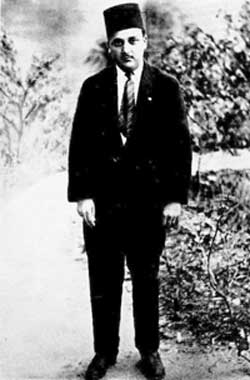
In the early years after the passing of 'Abdu'l-Bahá, Shoghi Effendi spent his summers in the mountains of Switzerland, walking, often for ten to sixteen hours a day. He ate almost nothing until he came back at night. Then he went to a small hotel and ordered fried potatoes, fried eggs and salad, because they were cheap and filling, and went up to his little room under the eaves to sleep.
Rúhíyyih Khánum, who became his wife, writes that he had a rigid discipline and applied it both to himself and to those who were with him. "A sum, less than modest in amount, was set aside for the summer." Whether he was alone with one relative acting as his companion and secretary, or other members of the family joined him, that sum had to suffice. If more people came, the economy had to be greater.
"He never travelled other than third class, even when he was a middle-aged man." She could remember very few times when they went anywhere by train in first or second class, and then only because the third-class carriage was too dirty or too full to use. If he travelled by night he slept on the hard wooden benches, "his head on his rucksack," more than those who travelled with him could stand.
She explains that he kept two standards. As Head of the Faith, before the public, he was identified with the honour of the Cause, which was his own honour. As a private person, travelling unknown, he was a modest man "who was reluctant to spend on luxury the funds his high office placed at his disposal." She adds: "He was not accountable to anyone in the world, no Bahá'í on earth would question anything he chose to do, but he questioned himself and he was a difficult taskmaster."
As he grew older and his burden wore him down, she pressed him as far as she dared to be a little less harsh with himself: to accept the modest comforts of a decent hotel and a room with a bath, to take a cure for his health now and then, and, since he ate only once a day, to let that meal be more nourishing.
He accepted a slight change, she says, only because of Milly Collins. Milly loved him greatly, and she formed the habit of offering him a sum of money before his summer rest began, begging him to use it for himself, for whatever he wanted.
Even then it took vehement appeals from Rúhíyyih Khánum, urging him to accept what Milly had given with such love and concern for him personally, before he would use a small portion of it on himself. The rest he spent on purchases for the gardens, the Holy Places and the Archives. "This gave him real pleasure," she writes, "so Milly's intention was fulfilled in one way or another."
The same care ran through all his dealings with money. She never saw him settle a bill he had not first added up himself, whether it was for a meal or for thousands of dollars, and if he found an undercharge he pointed that out too. More than once a beautiful ornament for the Shrines, the Archives or the gardens was offered at a price he thought too high. He wanted it and had the money, but if the seller would not meet his price he would not buy it. "He just considered it wrong and would not do it." When spare parts for his car could not be had in the worst years of the war, he had it sold and used taxis. He could have bought another car, she remarks, but it never entered his mind.
He was against extravagance, ostentation and luxury as such, she writes, and denied himself and others many things he felt were not justified or not appropriate.
This is a retelling. For the fuller account, see The Priceless Pearl by Rúhíyyih Khánum.
Record yourself reading this story
Recording stays on this device only. Nothing is uploaded.
Related stories
A Kaross for the Guardian
In 1955 John and Audrey Robarts gave Shoghi Effendi a springbok-skin kaross from Bechuanaland. After the Guardian's passing, Rúhíyyih Khánum showed John Robarts that it had been his prayer mat.
How God Passes By Was Written
During the Second World War the Guardian wrote God Passes By, his review of the first Bahá'í century, racing to finish it in time for the Centenary. Rúhíyyih Khánum, who proofread it with him late into the night, recorded what the work cost him.
The Guardian's Letter to the United Nations
In July 1947 the United Nations Special Committee on Palestine asked Shoghi Effendi whether the Bahá'ís wished to submit a statement. His reply explained the Faith's ties to the Holy Land and declined to take any political side.
The Guardian's Newspaper Clippings
Rúhíyyih Khánum recalls how the Guardian, weighed down by burdens, tore from The Times only the articles he wanted, threw the rest away, and handed her long streamers of clippings to read.