A Question in the Englewood Garden
Mírzá Maḥmúd-i-Zarqání, Mahmúd's Diary: The Diary of Mírzá Maḥmúd-i-Zarqání, (1998)
When in Bahá'í history
How this story reached us
- 1.Mahmúd's Diary, entry headed "Friday, June 28, 1912 [Montclair -- West Englewood]" (events of Saturday 29 June 1912 per editor's note 176), pp. 149-152 (narr/mahmud.txt; wrapped copy narr/wrapped/mahmud.txt lines 2647-2701; note 176 in the notes section)
A retelling based on Mahmúd's Diary by Mírzá Mahmúd-i-Zarqání. Words in quotation marks are as recorded in that account.
'Abdu'l-Bahá had invited the friends in New York to a Unity Feast at West Englewood, New Jersey. On the morning of the feast, Mahmúd records, He left Montclair at half past eight, passed through New York, changed trams four times, passed twice by the river, and reached Englewood at noon, tired from the journey and the warm weather. He rested briefly at the home of Roy Wilhelm while the friends arrived from the surrounding towns and gathered on the lawn beside the house.
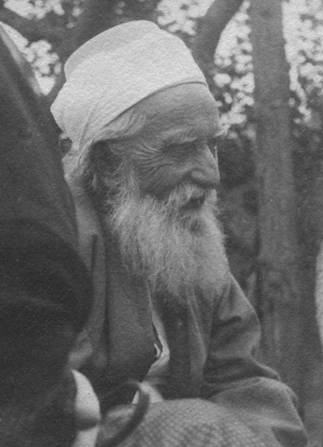
Almost two hundred people sat in a circle under the trees and were served by the Bahá'ís. The lawn was strewn with flowers, so that it seemed, Mahmúd wrote, "as if an embroidered carpet had been spread." The Master spoke to them about the greatness of the Cause, the influence of the Word of God and the need for unity among the friends, and counselled them to be truthful and faithful. He walked in the rose garden and allowed His photograph to be taken. When a minister and another visitor came, He took them into the house and talked with them until dinner. When the friends were seated at the table, He went round with vials of attar of rose and anointed each of them, one by one.
He told them: "This meeting will be productive of great results. It will be the cause of attracting a new bounty. This day in which we have come together is a new day, and this hour a new hour."
There were two more meetings, one in the afternoon and one in the evening, for friends who had not been able to come to the first. They sat on chairs and benches in rows in the garden next to Mr Wilhelm's house. After a short walk 'Abdu'l-Bahá sat down among them, asked for a prayer to be chanted, and spoke, encouraging the friends to spread the fragrances of God.
As He was about to leave, one of the seekers asked Him: "What are the new teachings of this Cause that are not to be found in the other great religions?"
The Master stood in the centre of the garden and called everyone to come near. They stood in two rows, and He walked between the rows and spoke. Mahmúd says His explanation was so magnificent that everyone was astonished. While He was speaking, a carriage and an automobile passed nearby. When the people in the carriage came close and saw 'Abdu'l-Bahá, they stopped, got down, and listened too, and they were drawn to the teachings.
He described the teachings one by one: the oneness of humankind; universal peace; association with all religions; forgiveness of enemies and the prohibition of cursing one's foes; equal rights for men and women; the House of Justice and the International Tribunal; compulsory education for boys and girls; the prohibition of war between nations and governments; and the harm of every form of prejudice, racial, religious, sectarian, patriotic and political. He spoke on each at length.
At the end He asked them whether these principles had been brought by the religions of the past and recorded in their books. They all answered no.
"The inquirer was so overwhelmed," Mahmúd wrote, "that he clapped his hands in delight, expressing his joy and gratitude."
Because it was a moonlit night, the talk was given out in the garden, and so it was not recorded. The same explanations, Mahmúd notes, can be found in 'Abdu'l-Bahá's other addresses.
After the meeting the Master remarked: "If these persons were to be confronted with the question, what new teachings did Christ bring other than changing the laws of the Sabbath and divorce, they would be utterly confounded."
He stayed in Englewood that night.
This is a retelling. For the fuller account, see Mahmúd's Diary by Mírzá Mahmúd-i-Zarqání.
Cite this story
Maḥmúd-i-Zarqání, M.. (1998). *Mahmúd's Diary: The Diary of Mírzá Maḥmúd-i-Zarqání*.
Record yourself reading this story
Recording stays on this device only. Nothing is uploaded.
Related stories
The Question at Brooklands
At the Brooklands aviation ground in September 1911, a young Hindu learning to fly asked 'Abdu'l-Bahá's friends who their visitor was. Told it was 'Abdu'l-Bahá, whose teachings he had studied, he went to meet Him.
Where, Where Is the Sun of Truth?
In Paris in 1911 'Abdu'l-Bahá told an artist that all true art is a gift of the Holy Spirit. The artist's questions led to the blind eyes that cannot see the Sun of Truth, and the Master answered with a prayer.
The Storm at the Unity Feast
At the Unity Feast in West Englewood in June 1912, a sudden storm broke just as the meal was announced. Juliet Thompson watched ‘Abdu’l-Bahá sit at a distant crossroad, His face upturned to the sky, until the clouds raced away.
Acknowledged by the People of ‘Akká
The pilgrim Roy Wilhelm observed that people of all classes and religions in ‘Akká came to ‘Abdu’l-Bahá for explanation of their scriptures and settlement of their disputes, and that a just Governor sent his son to Him for instruction.