The Question at Brooklands
'Abdu'l-Bahá, 'Abdu'l-Bahá in London
When in Bahá'í history
How this story reached us
- 1.'Abdu'l-Bahá in London, sections "At Byfleet" (second visit, 28-29 September 1911), "The Captivity of Man" and "At Brooklands" (gut/19250.txt lines 1906-1931, 1932-1951, 1995-2028 and 2295-2325)
A retelling based on 'Abdu'l-Bahá in London. Words in quotation marks are as that record gives them.
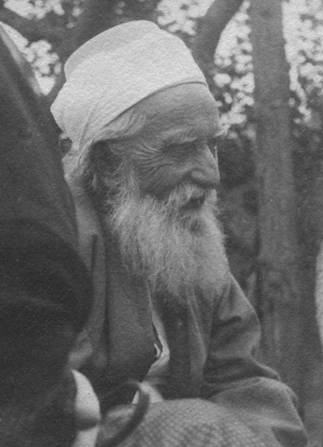
On September 28, 1911, 'Abdu'l-Bahá motored down from London to Byfleet for a second visit to Vanners, a little farmhouse on an old royal manor dating back to the time of Edward II. He stayed the night and returned on the evening of the next day.
On the drive He passed two detachments of Boy Scouts tramping along the road. He was told their motto, "Be Prepared," that an act of kindness each day was one of their laws, and that some of these boys had put out a fire and helped at a recent railway accident. "This makes me very happy," He said.
A large and strangely mixed crowd was waiting at the gate of Vanners, from the very poor to the wealthy who had motored over from their country places. As many as could pressed into the garden and sat down around Him, and the silence was most impressive. Someone asked about the elaborate civilization of the West, and He answered with a talk on the captivity of man.
"The bird is a captive in the air and the fish a captive in the sea. Man alone stands apart and says to the elements, I will make you my servants! I can govern you!" Man takes electricity, He said, and makes of it a power for lighting and a means of communication across thousands of miles. "But man himself may become a captive to the things he has invented." A man is truly free, He said, only when he is not a captive to his desires.
All day long people gathered at the gate hoping to see Him. More than sixty drove or cycled to Vanners, "many wishing to question him on some special subject": clergy of several denominations, the headmaster of a boys' school, a member of Parliament, a doctor, journalists, a well known poet and a magistrate from London. When He walked into the village, ragged children clustered around Him by the dozen. One poor tramp exclaimed, "He is a good man," and added, "Ay, he's suffered!" In the afternoon He sat in the bow window with His arm around a very ragged but very happy little boy, who had come to ask Him for sixpence for his money box and for his invalid mother.
On the morning of the second day a neighbour sent over her car and asked whether 'Abdu'l-Bahá would like to take His guests to the Brooklands aviation ground. It was windy, but an aviator was out on the track, and when he heard who the visitor was he offered to fly for Him. 'Abdu'l-Bahá left His friends and walked out into the middle of the course, where He stood alone watching the biplane make wide circles above Him.
A Hindu who was learning to fly at the school came over to 'Abdu'l-Bahá's friends and asked:
"Who is the man in Eastern dress?"
When they told him, he exclaimed, "Oh I know him very well through his teachings, which I have studied," and at once went to meet 'Abdu'l-Bahá.
The two talked together for some time in Arabic, the young man showing great joy at being in His presence. He said afterwards that for many years he had longed for this moment.
They had tea out of doors. 'Abdu'l-Bahá and the young Hindu sat at the head of the long benches and talked merrily with everyone. 'Abdu'l-Bahá noticed two of the airmen wrestling on the ground, and when they stopped He went over to them, clapping His hands and calling out in English, "Bravo! Bravo! that is good exercise."
After His return to Egypt, 'Abdu'l-Bahá sent a message of remembrance to the people of Byfleet, saying that He would never forget them.
This is a retelling. For the fuller account, see 'Abdu'l-Bahá in London.
Record yourself reading this story
Recording stays on this device only. Nothing is uploaded.
Related stories
The Mathematician at the Window
In the summer of 1911 Juliet Thompson met two professors from New York near 'Abdu'l-Bahá on Lake Geneva. One lunched with Him and asked his questions; the other stayed away and watched from a window.
Where, Where Is the Sun of Truth?
In Paris in 1911 'Abdu'l-Bahá told an artist that all true art is a gift of the Holy Spirit. The artist's questions led to the blind eyes that cannot see the Sun of Truth, and the Master answered with a prayer.
A Question in the Englewood Garden
After the Unity Feast at West Englewood in 1912, a seeker asked 'Abdu'l-Bahá what this Cause taught that earlier religions did not. He answered in the moonlit garden, naming its teachings one by one.
Freed from Imitations and Superstitions
O ye two blessed souls! Your letters were received.