Hudson Maxim and the Guns of Love
bahaistories.com archive · Read original
When in Bahá'í history
New York (today: New York, USA)
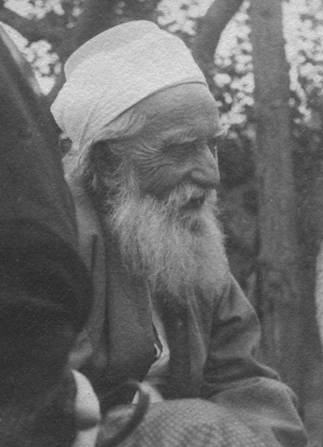
Hudson Maxim awoke with a swollen cheek and bags under his eyes. A toothache had kept him up for most of the night. He should have gone to the dentist, but there was a puzzle to solve so he went to his lab instead. With his right hand he lifted a pair of tongs to place a grey crystal of mercury fulminate in the fire. He held the next piece ready in his bare left hand: in his unpredictable line of work — explosives — Maxim knew better, but this was a sleepy morning and his mouth hurt. The instant the irons in his right hand touched the flame, his left hand exploded, torn off at the wrist in a crack of pain and a flash of light.
That was eighteen years ago. Today, on April 15, 1912, the one-handed Hudson Maxim stood in the fifth-floor reception room of Suite 111 at the Hotel Ansonia, awaiting a word with ‘Abdu’l-Bahá. He had come to talk about war.
‘Abdu’l-Bahá greeted him in English (“Welcome! Welcome! Very welcome!”), they exchanged pleasantries, then Maxim got down to business.
“I understand you are a messenger of peace to this country,” he began. “What is your opinion about modern war?”
“Everything that prevents war is good,” ‘Abdu’l-Bahá replied.
War was the Maxim family business. Hiram, his elder brother, had invented the Maxim machine gun. The younger Hudson’s claim to fame was smokeless gunpowder.
“Do you consider the next great national war necessary?” Maxim asked.
“Why not try peace for awhile?” ‘Abdu’l-Bahá answered. “If we find war is better, it will not be difficult to fight again; but if we find that peace is the glorification of humanity, the impulse of true civilization, the stimulus to inventive genius and the means of attainment to the good-pleasure of God, we must agree to adhere to it and establish it permanently.”
‘Abdu’l-Bahá invited Maxim to consider the world beyond the narrow confines of the battlefield. “The possibilities are incalculable, inconceivable,” He said, “the after effects even more dreadful than the initial shock. . . . The country suffers beyond all power of estimation; agriculture is crippled, abandoned, sustenance fails, poverty and suffering continue long afterward.”
Maxim tried a different tack: “Fewer are killed in modern engagements than in the battles of ancient times; the range is longer and the action less deadly.” A little later he added, “War is no more dangerous now than automobiling.”
When ‘Abdu’l-Bahá spoke of the destruction caused by modern bombs, Maxim drew a diagram. “The effect of a bomb,” he explained, “is not so great as expected. Most of its force is expended upward into the air. It is impossible to mass men close enough to it for a full utilization of its energy.”
‘Abdu’l-Bahá answered that the greatest intelligence of man was being spent on killing his fellow-man, and then He turned the subject toward Maxim himself.
“You are a celebrated inventor and scientific expert whose energies and faculties are employed in the production of means for human destruction . . . . Now you have the opportunity of becoming doubly famous. You must practice the science of peace. . . . You must discover the means of peace; invent guns of love which shall shake the foundations of humanity.”
“Then it will be said by the people of the world, this is Mr. Maxim, inventor of the guns of war, discoverer of high explosives, military scientist, who has also discovered and invented means for increasing the life and love of man; who has put an end to the strife of nations and uprooted the tree of war. . . . Then will your life become pregnant and productive with really great results. . . . God will be pleased with you and from every standpoint of estimation you will be a perfect man.”
Source: Jonathan Menon, “An Arms Dealer Tries to Sell War to ‘Abdu’l-Bahá,” 239 Days in America (http://239days.com/2012/04/15/an-arms-dealer-tries-to-sell-war-to-abdul-baha/). The conversation is from Howard MacNutt's notes of the interview at the Hotel Ansonia, Star of the West, vol. 3, no. 7 (1912), pp. 5–6 and 10–11.
Collected from bahaistories.com (Subject: war).
Cite this story
Various. *bahaistories.com archive*. https://bahaistories.com/subject/war
Record yourself reading this story
Recording stays on this device only. Nothing is uploaded.
Related stories
Shall Man Fight for the Tomb?
Near the end of a long address at Stanford University in 1912, ‘Abdu’l-Bahá asked why anyone would fight and kill over the earth, which is in the end only our grave.
Mankind Is in Danger
O people of the world! The dawn of the Sun of Reality is assuredly for the illumination of the world and for the manifestation of mercy.
Righteous Warfare
Although Bahá’u’lláh, like Christ, counsels His follows as individuals and as a religious body to adopt an attitude of nonresistance and forgiveness toward their enemies, He teaches that it is the duty of the community to prevent injustice and oppression.
A Warning of a Great War
In San Francisco on 22 October 1912, ‘Abdu’l-Bahá foretold a great war and said the generality of mankind would one day reproach statesmen who send them into war while they themselves live in comfort.