Left Behind at Naples
Rúhíyyih Khánum, The Priceless Pearl, (1969)
When in Bahá'í history
How this story reached us
- 1.The Priceless Pearl, ch. 2, pp. 18-20 (narr/wrapped/khanum_priceless_pearl.txt lines 431-490)
- 2.Mahmúd's Diary, 28-30 March 1912, aboard the Cedric (narr/wrapped/mahmud.txt lines 175-203)
A retelling based on The Priceless Pearl by Rúhíyyih Khánum, with details from Mahmúd's Diary by Mírzá Mahmúd-i-Zarqání. Words in quotation marks are as recorded in those accounts.
In September 1910 'Abdu'l-Bahá left Haifa by ship for Port Said without telling anyone He was going. One of the believers remembered that a little before sunset that day, His grandson Shoghi Effendi was sitting on the steps of the Master's house, "disconsolate and forlorn," and said: "The Master is now on board the ship. He has left me behind, but surely there is a wisdom in this!" or words to that effect.
The Master lost no time in sending for him.
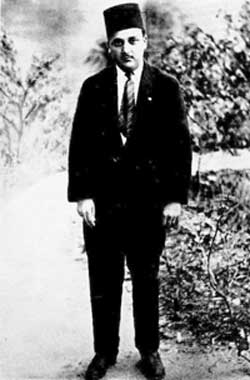
After His return from Europe at the end of 1911, 'Abdu'l-Bahá made a larger plan: to take Shoghi Effendi with Him to America. He ordered long robes for the boy, and two turbans, one green and one white like His own, for him to wear in the West. When they were delivered, Shoghi Effendi put them on to show his grandfather. Years later he told his wife, Rúhíyyih Khánum, that the Master's eyes shone with pride and pleasure.
On 25 March 1912 'Abdu'l-Bahá, Shoghi Effendi and several secretaries and servants sailed from Alexandria on the S.S. Cedric.
The ship docked at Naples on 28 March. Italy and Turkey were at war, and the friends urged the Master and His companions not to go ashore, since their Eastern dress and Turkish fezzes would stir up hostility. So 'Abdu'l-Bahá stayed on board and looked at the city from the deck. That day He spoke of the hardships of coal miners and the needs of working people.
The next day, Mírzá Mahmúd records, doctors from Naples came aboard to examine the passengers' eyes. The ship's own doctor had already said that the eyes of one of the servants were infected. The Italian doctors declared that the eyes of Shoghi Effendi and of one of the secretaries were infected too, and that all three must leave the ship. 'Abdu'l-Bahá, His companions and the American believers who had come aboard all tried to change the decision. The doctors insisted that even if the three went on to New York they would not be allowed to land and would be sent back. The efforts, Mahmúd wrote, "were of no avail and apparently were not in accord with God's mysterious will and plan. ... Therefore 'Abdu'l-Bahá asked the three to obey."
On Saturday, 30 March, He gave them His utmost kindness and blessings and said goodbye. They left the ship in great sadness. The Master's heart was broken, Mahmúd wrote, and all His companions grieved. "There is a wisdom in this matter which will become known later," 'Abdu'l-Bahá said. That afternoon the Cedric sailed for New York.
At dinner that evening He said to His companions: "These Italians took us for Turks. They sent a report to this effect and stopped three of our party from proceeding. One was a secretary, the other a cook. If they had stopped only these two it would have mattered little. But why should they treat that tender youth Shoghi Effendi so harshly?"
Shoghi Effendi told his wife long afterward that there had been nothing the matter with his eyes; he always had very strong eyes. He was fifteen, deeply attached to his grandfather, and excited about the great ship and the journey west, at a time when such voyages were relatively rare. Rúhíyyih Khánum writes that he always remembered the episode with sadness, "but in a touching spirit of submissiveness to the constant blows he received all his life."
About six months later he wrote to one of 'Abdu'l-Bahá's secretaries in America. He had subscribed to Star of the West, he said, but some copies had not reached him; would the secretary make sure he received every issue with reports of the Master's travels? From October, he added, his address would be the Syrian Protestant College in Beirut, which he was about to enter. He signed the letter "Choki Rabbani."
This is a retelling. For the fuller account, see The Priceless Pearl by Rúhíyyih Khánum, chapter 2, and Mahmúd's Diary, 28–30 March 1912.
This story shares quotes with 1 other story
“There is a wisdom in this matter which will become known later,”
Also in
- The Crossing on the Cedric— Mírzá Maḥmúd-i-Zarqání, Mahmúd's Diary: The Diary of Mírzá Maḥmúd-i-Zarqání
Record yourself reading this story
Recording stays on this device only. Nothing is uploaded.
Related stories
Sharing the Burden: Bahíyyih Khánum in Baghdád
Shoghi Effendi's tribute to Bahíyyih Khánum recalls the years of crisis in Baghdád — when Mírzá Yaḥyá's faithlessness had unsettled the Bábí community and Bahá'u'lláh had retreated for two years to the mountains of Sulaymáníyyih — the tender solicitude she showed as a child in His absence, and the delicate, grave missions He entrusted to her in her teens.
Advise Remain Sofia
When war broke out, Shoghi Effendi advised Marion Jack, a pioneer in Sofia, to return to Canada. She begged to stay at her post, and he changed his instructions and wired: "Advise remain Sofia love."
The Life of ‘Abdu’l-Bahá
A biography of ‘Abdu’l-Bahá, from His childhood in Tehran and long years of exile and imprisonment to His ministry as Center of the Covenant, His journeys to the West, His writings and His passing in Haifa in 1921.
Louis George Gregory
Born in Charleston to formerly enslaved parents, Louis G. Gregory became a Bahá'í in 1909, was seated by 'Abdu'l-Bahá at His right in Washington, gave decades to teaching and race unity, and was posthumously named a Hand of the Cause.