Forty Years to the Last Step
Shoghi Effendi, God Passes By
When in Bahá'í history
How this story reached us
- 1.God Passes By, Chapter XXII (gut/19275.txt lines 13686-13815: the history, construction, materials and dimensions of the Wilmette House of Worship)
- 2.God Passes By, Chapter XXI (gut/19275.txt lines 11966-11977: 1920 Convention selects the Bourgeois design; excavation and basement)
- 3.Mahmúd's Diary (narr/mahmud.txt: entry for Saturday, July 13, 1912 [New York -- West Englewood], dinner at the home of Louis Bourgeois; glossary entry "Bourgeois, Louis (d. 1930)")
A retelling based on God Passes By by Shoghi Effendi, with two details from Mahmúd's Diary. Words in quotation marks are as those books give them.
In March 1903 the "House of Spirituality" of the Bahá'ís of Chicago, the first Bahá'í centre in the Western world, wrote to 'Abdu'l-Bahá asking permission to build a Temple in America. They had been inspired, Shoghi Effendi records, by the example of the believers who were building a House of Worship in 'Ishqábád. In June of that year 'Abdu'l-Bahá gave His approval in a Tablet.
In November 1907 delegates from various American Assemblies met in Chicago to choose a site. Shortly after the first American Bahá'í Convention, held in March 1909, a religious corporation called the "Bahá'í Temple Unity" was incorporated to carry the work forward on a national basis. In May 1912 'Abdu'l-Bahá Himself came to the site and dedicated the ground. At the Convention of 1914 the purchase of the Temple property was completed.
'Abdu'l-Bahá directed the Convention of 1920, held in New York, to select the Temple's design. It chose, from among a number of designs submitted in competition, that of Louis J. Bourgeois, a French-Canadian Bahá'í architect, and 'Abdu'l-Bahá later confirmed the choice. Mahmúd's Diary records that on a July evening in 1912 'Abdu'l-Bahá had gone to Bourgeois's home for dinner.
Contracts were awarded in December 1920 and August 1921 for the nine great caissons that support the central portion of the building, reaching rock "at a depth of 120 feet below the ground level," and for the basement. The raising of the superstructure, Shoghi Effendi writes, came after 'Abdu'l-Bahá's passing.
Since 1912 the work had moved forward only intermittently. It went ahead in earnest once the American community had built up the administrative institutions it needed to carry it through. In August 1930 the contract for the superstructure was placed, with twenty-four sub-contracts besides, "in spite of the prevailing economic crisis, and during a period of unemployment unparalleled in American history." Bourgeois died that same year, according to the glossary of Mahmúd's Diary.
The structure was complete by May 1, 1931. On that day the first devotional service was held in it, nineteen years to the day after 'Abdu'l-Bahá had dedicated the ground.
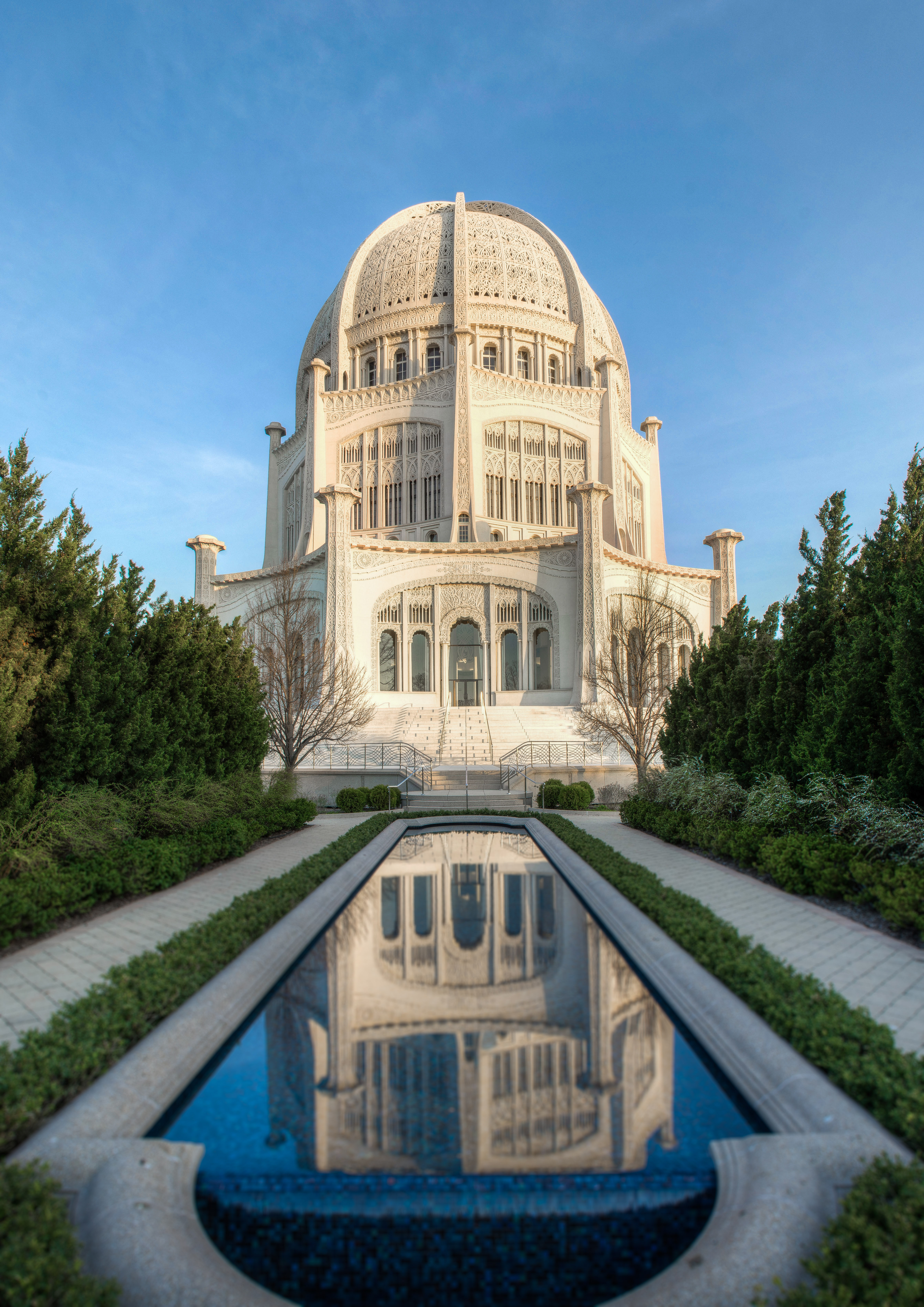
The exterior ornamentation followed in stages. The dome was ornamented between June 1932 and January 1934, the clerestory by July 1935, and the gallery unit below it by November 1938. The main storey was begun in April 1940 and, "despite the outbreak of the present war," completed in July 1942. By December 1942 the eighteen circular steps around its base were in place, forty years after the believers of Chicago had first asked.
Shoghi Effendi describes the building: a pure white structure with nine sides, rising from a flight of white stairs, crowned by a dome forty-nine feet high and ninety feet across. Nine ribs soar to the apex of the dome and merge there into a common unit pointing skyward. A third of the dome's surface is pierced, "to admit light during the day and emit light at night." From the floor of the basement to the top of the ribs the building rises 191 feet. It has nine entrances, one of which faces 'Akká, and above each is a quotation from the writings of Bahá'u'lláh. The ornamentation is a mixture of crystalline quartz, opaque quartz and white Portland cement, "hard and enduring as stone, impervious to the elements, and cast into a design as delicate as lace."
It cost over a million dollars, given by the American Bahá'í community with help at times from believers of Christian, Muslim, Jewish, Zoroastrian, Hindu and Buddhist background. Its first phase, Shoghi Effendi writes, was associated with 'Abdu'l-Bahá, and its last stages with the memory of the Greatest Holy Leaf, the Purest Branch and their mother. Between June 1932 and October 1941 more than 130,000 visitors came to it. He called it a great "Silent Teacher" of the Faith, and "the first fruit of a slowly maturing Administrative Order." When he wrote, its interior ornamentation was "as yet unbegun."
'Abdu'l-Bahá had written of it in the Tablets of the Divine Plan: "Out of this Mashriqu'l-Adhkár, without doubt, thousands of Mashriqu'l-Adhkárs will be born."
This is a retelling. For the fuller account, see God Passes By by Shoghi Effendi.
Record yourself reading this story
Recording stays on this device only. Nothing is uploaded.
Related stories
Corinne True and the Temple Fund
As financial secretary of Bahai Temple Unity, Corinne True of Chicago gathered gifts from across America and the East for the House of Worship at Wilmette. She lived to see it dedicated in 1953 and was known as the Mother of the Temple.
Pray Assure American Believers
PRAY ASSURE AMERICAN BELIEVERS BEHALF HOLY FAMILY MYSELF ABIDING APPRECIATION NUMEROUS EVIDENCES THEIR VALUED SYMPATHY.
Spiritual Assemblies
Before ‘Abdu’l-Bahá completed His earthly mission, He had laid a basis for the development of the administrative order established in Bahá’u’lláh’s Writings.
The Administrative Order
It has been the general characteristic of religion that organization marks the interruption of the true spiritual influence and serves to prevent the original impulse from being carried into the world.