A Sweet Taste on Your Lips
'Abdu'l-Bahá, The Promulgation of Universal Peace, (1922)
When in Bahá'í history
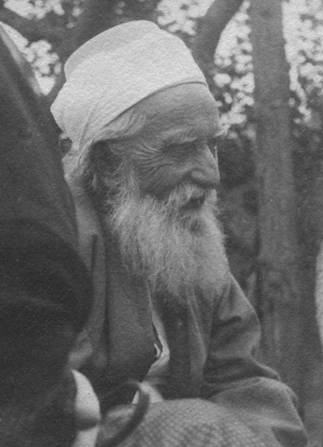
How this story reached us
- 1.The Promulgation of Universal Peace (gut/19285.txt lines 16293-16385: talk of 1 November 1912 at the home of Mrs. Corinne True, 5338 Kenmore Avenue, Chicago)
- 2.Memorials of the Faithful (gut/19279.txt lines 5596-5623: the law "better for you to be killed than to kill"; the Yazd martyrs; the man with the sugar candy)
- 3.Mahmud's Diary (narr/mahmud.txt, entries for Thursday 31 October and Friday 1 November 1912; wrapped copy scratchpad/wrap/mahmud.txt lines 6035-6045 and 6197-6202)
A retelling based on The Promulgation of Universal Peace by 'Abdu'l-Bahá, with passages from His Memorials of the Faithful and from Mahmúd's Diary. Words in quotation marks are as those books record them.
On the evening of 1 November 1912 'Abdu'l-Bahá spoke to the believers of Chicago at the home of Corinne True on Kenmore Avenue.
He had arrived in Chicago by train the day before. Mírzá Maḥmúd, who travelled with Him, wrote that the friends at the station "were transported with joy on seeing the Master's face." In His talk at Mrs True's home He told the friends this was His third visit to their city. It had been thought that He would go directly from San Francisco to New York and on to the East, "but impelled by excessive love, I have visited Chicago again."
On 1 November, Maḥmúd records, He also spoke of His own health: "My health was absolutely not up to traveling but the assistance of the Blessed Beauty helped me." When He left Syria, He said, He had been ill and weak and not used to travelling, and all had been astonished.
That evening He told the friends that their faces were radiant, and He spoke of Bahá'u'lláh, Who had endured hardships for nearly fifty years without any trace of sadness being seen on His face. "Even in prison He was like a king enthroned in majesty and greatness," He said. "Remember: He was a prisoner--He was in prison."
Then He spoke of the martyrs. When the Cause appeared in the East, He said, its followers gave up everything, and although life is the most precious thing on earth, twenty thousand had offered theirs willingly. "Recently, in Yazd two hundred of the Bahá'í friends were cruelly slain."
They went to the place of martyrdom, He said, "in the utmost ecstasy of attraction, smiling with joy and gratitude upon their persecutors." Some of them offered sweetmeats to their executioners, saying, "Taste of this in order that with sweetness and enjoyment you may bestow upon us the blessed cup of martyrdom." Women were among them, and they were put to death with great cruelty. Through all of it, He said, not one of the friends objected or recanted.
"They offered no resistance, although the Bahá'ís in that city were most courageous and strong." One of them, He said, could in physical strength have withstood many of their enemies, but they accepted martyrdom in a spirit of complete resignation. Many of them died crying out, "O Lord! Forgive them; they know not what they do."
'Abdu'l-Bahá wrote of the same events in Memorials of the Faithful. There He explains that in the earliest days of the Faith, before its reality was made plain, a believer might still strike back. But with Bahá'u'lláh the law of retaliation was done away with, and the foundation of the Law of God became this: "It is better for you to be killed than to kill." So when in Yazd men, women and children were attacked and killed, "not one of the friends of God lifted a hand against them." Among those martyrs, He writes, was a man who, when he saw the drawn sword over him, "thrust sugar candy into his murderer's mouth and cried, 'With a sweet taste on your lips, put me to death--for you bring me martyrdom, my dearest wish!'"
At the close of His talk in Chicago, 'Abdu'l-Bahá reminded His listeners of prophecies that when the standard of God appears in the East, its signs will become evident in the West. The friends in the East, He said, were waiting to hear that the believers in the West had become "firm and steadfast." He hoped the promise would be fulfilled in them.
This is a retelling. For the fuller account, see The Promulgation of Universal Peace by 'Abdu'l-Bahá (talk of 1 November 1912) and Memorials of the Faithful.
Record yourself reading this story
Recording stays on this device only. Nothing is uploaded.
Related stories
A Martyr's Widow in the Master's Household
On pilgrimage, Corinne True met the martyr's widow who served tea to the Master's family each morning, and marvelled at His household of over forty people of many races and nations, where no word of dispute was heard.
Corinne True Is Asked to Speak
Before leaving for Minneapolis, ‘Abdu’l-Bahá asked Corinne True to speak about the Faith in public; when she protested that she had no training, He told her to turn her heart wholly toward Him.
The Temple Is Already Built
At the dedication of the Temple site in Wilmette on 1 May 1912, the golden trowel could not break the ground, so ‘Abdu’l-Bahá swung an axe. Women and people of many races then dug, and He declared the Temple already built.
Corinne True’s Sorrows
When Corinne True tearfully told ‘Abdu’l-Bahá of the sad things she had had to bear, His answer brought peace to her heart, and she later became a great support for anyone who had lost a loved one.