The Guardian Directs the Excavation
bahaistories.com archive · Read original
When in Bahá'í history
Haifa (today: Haifa, Israel)
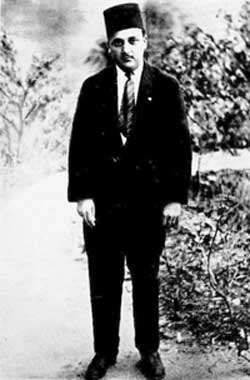
During 1948 Shoghi Effendi himself undertook—for the second time in twenty years—the excavation of rock behind the Shrine in order to enlarge the area sufficiently to enable the arcade to be built. This was a tremendous work, involving the removal of hundreds of square metres of stone. The ingenuity of the Guardian was continually displayed as this work proceeded: he had a second-hand set of rails and a cart purchased, laid down on the path which ran parallel with the Shrine and in front of it, and the excavated material, directed down wooden chutes, carted off to the easternmost point of the terrace and dumped as fill for the extension of the terrace itself.
From early morning until dark, often more than eight hours on his feet, day after day and month after month he directed the work. It was certainly not his work to do this, but he was determined to ensure it was done not only quickly, but economically, and there was no one else with the will power and stamina it required to take his place. It was in ways such as this, with indefatigable determination and unflagging perseverance, that Shoghi Effendi made of the Holy Places at the World Centre what we see before us today.
Source: Rúhíyyih Khánum, The Priceless Pearl, pp. 243–244.
Collected from bahaistories.com (Subject: willpower).
Cite this story
Various. *bahaistories.com archive*. https://bahaistories.com/subject/willpower
Record yourself reading this story
Recording stays on this device only. Nothing is uploaded.
Related stories
The Guardian in the Swiss Mountains
In the years after ‘Abdu’l-Bahá’s passing, Shoghi Effendi often withdrew to Switzerland to recover his health and strength, walking for many hours and climbing in the Bernese Alps.
The Most Vital and Challenging Issue
In The Advent of Divine Justice, Shoghi Effendi called racial prejudice the most vital and challenging issue before the American Bahá'ís, asked both races for a supreme effort, and gave minorities priority when votes or qualifications were equal.
The Guardian’s Unfinished Plans
Leroy Ioas recalls that until Shoghi Effendi passed away in England he was sending cables about work to finish before his return, which suggests he did not expect to die.
Like a Drop Beside the Ocean
Leroy Ioas recalls the Guardian's humility: Shoghi Effendi never spoke of "the days of the Guardian", and he stopped Ioas from ever mentioning his name in the same breath as the Master's.