The Dervish by the Roadside
Baha'i Stories Blog · Read original
When in Bahá'í history
Núr (today: Núr, Mázandaran, Iran)
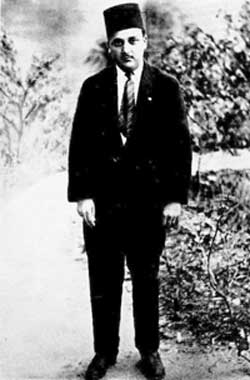
One day, in the course of one of His riding excursions into the country, Bahá’u’lláh, accompanied by His companions, saw, seated by the roadside, a lonely youth. His hair was dishevelled, and he wore the dress of a dervish. By the side of a brook he had kindled a fire, and was cooking his food and eating it. Approaching him, Bahá’u’lláh most lovingly enquired: “Tell Me, dervish, what is it that you are doing?” “I am engaged in eating God,” he bluntly replied. “I am cooking God and am burning Him.” The unaffected simplicity of his manners and the candour of his reply pleased Bahá’u’lláh extremely. He smiled at his remark and began to converse with him with unrestrained tenderness and freedom. Within a short space of time, Bahá’u’lláh had changed him completely. Enlightened as to the true nature of God, and with a mind purged from the idle fancy of his own people, he immediately recognised the Light which that loving Stranger had so unexpectedly brought him.
That dervish, whose name was Mustafá, became so enamoured with the teachings which had been instilled into his mind that, leaving his cooking utensils behind, he straightway arose and followed Bahá’u’lláh. On foot, behind His horse, and inflamed with the fire of His love, he chanted merrily verses of a love-song which he had composed on the spur of the moment and had dedicated to his Beloved. “Thou art the Day-Star of guidance,” ran its glad refrain. “Thou art the Light of Truth. Unveil Thyself to men, O Revealer of the Truth.” Although, in later years, that poem obtained wide circulation among his people, and it became known that a certain dervish, surnamed Majdhúb, and whose name was Mustafá Big-i-Sanandají, had, without premeditation, composed it in praise of his Beloved, none seemed to be aware to whom it actually referred, nor did anyone suspect, at a time when Bahá’u’lláh was still veiled from the eyes of men, that this dervish alone had recognised His station and discovered His glory.
Source: Nabíl, The Dawn-Breakers, translated and edited by Shoghi Effendi, pp. 117–118 (Bahá’u’lláh’s visit to Núr, 1844).
Collected from the Baha'i Stories Blog (https://bahaistories.blogspot.com/2020/05/1844-lonely-youths-encounter-with.html).
Cite this story
Various. *Baha'i Stories Blog*. https://bahaistories.blogspot.com/2020/05/1844-lonely-youths-encounter-with.html
Record yourself reading this story
Recording stays on this device only. Nothing is uploaded.
Related stories
Shaykh Ḥasan-i-Zunúzí, Who Saw the Twin Luminaries
A disciple of Siyyid Kázim, Shaykh Ḥasan met the Báb in Karbilá, later served Him as a scribe and go-between, and, as the Báb had promised, met Bahá’u’lláh in Karbilá in 1851.
The Life of Táhirih
‘Abdu’l-Bahá’s memorial of Táhirih: the learned woman of Qazvín who recognized the Báb, taught boldly in Karbilá and Baghdád, appeared unveiled at Badasht, and was put to death in Tihrán.
The Dream of ‘Abdu’l-Vahháb
After a dream, a young Shíráz shopkeeper, ‘Abdu’l-Vahháb, follows Mullá ‘Alíy-i-Basṭámí out of the city. His furious father beats Mullá ‘Alí, but later repents, and after his son’s martyrdom he is taught the Faith by Bahá’u’lláh.
The Three Uncles of the Báb
The Báb’s three maternal uncles took different paths: Ḥájí Mírzá Siyyid ‘Alí raised Him and died one of the Seven Martyrs of Tehran; Ḥájí Mírzá Siyyid Muḥammad received the Kitáb-i-Íqán; the youngest believed some years later.