Speech of Professor Michael Sadler
'Abdu'l-Bahá, 'Abdu'l-Bahá in London, (1912) · Read original
When in Bahá'í history
London (today: London, UK)
We have met together to bid farewell to ‘Abdu’l-Bahá, and to thank God for his example and teaching, and for the power of his prayers to bring Light into confused thought, Hope into the place of dread, Faith where doubt was, and into troubled hearts, the Love which overmasters self-seeking and fear.
Though we all, among ourselves, in our devotional allegiance have our own individual loyalties, to all of us ‘Abdu’l-Bahá brings, and has brought, a message of Unity, of sympathy and of Peace. He bids us all be real and true in what we profess to believe; and to treasure above everything the Spirit behind the form. With him we bow before the Hidden Name, before that which is of every life the Inner Life! He bids us worship in fearless loyalty to our own faith, but with ever stronger yearning after Union, Brotherhood, and Love; so turning ourselves in Spirit, and with our whole heart, that we may enter more into the mind of God, which is above class, above race, and beyond time.
Professor Sadler concluded with a beautiful prayer of James Martineau.
Mr. Eric Hammond said the Bahá’í movement stood for unity; one God, one people; a myriad souls manifesting the divine unity, a unity so complete that no difference of colour or creed could possibly differentiate between one Manifestation of God and another, and a sympathy so all-embracing as to include the very lowest, meanest, shabbiest of men; unity, sympathy, brotherhood, leading up to a concord universal. He concluded with a saying of Bahá’u’lláh, that the divine cause of universal good could not be limited to either East or West.
Miss Alice Buckton said we were standing at one of the springtimes of the world, and from that assembly of representatives of thought and work and love, would go out all over the world influences making for unity and brotherhood The complete equality of men and women was one of the chief notes of Bahá’í teaching.
Sir Richard Stapley pointed out that unity must not be sought in the forms and externals of religion, but in the inner spirit. In Persia there had been such an impulse towards real unity as was a rebuke to this so-called Christian country.
Mr. Claude Montefiore, as a Jew, rejoiced in the growth of the spirit of unity, and regarded that meeting as prophetic of the better time to come, and in some sense a fulfillment of the idea expressed by one who fell as a martyr to the Roman Catholic faith, Sir Thomas More, who wrote of the great Church of the Utopians, in which all varieties of creeds gathered together, having a service and liturgy that expressed the higher unity, while admitting special loyalties.
Mrs. Stannard dwelt on what that meeting and the sentiments expressed meant to the East, especially to the women, whose condition it was difficult for the West to understand.
Tammaddun’ul-Mulk testified to the unifying effect the Bahá’í movement had had in Persia, and of the wonderful way in which it had spread to America and other countries.
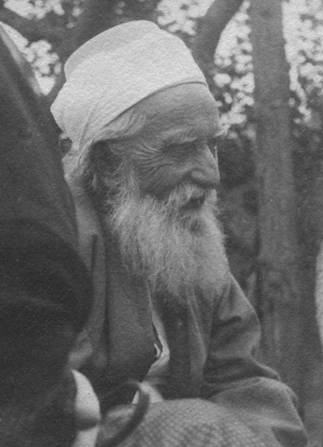
Then ‘Abdu’l-Bahá rose to give his farewell address. An impressive figure, the face rather worn but the eyes full of animation, he stood for about fifteen minutes, speaking in soft musical Persian. With hands extended, palms upwards, he closed with a prayer.
Source: 'Abdu'l-Bahá, 'Abdu'l-Bahá in London (1912). Public domain text from Project Gutenberg eBook #19250.
Cite this story
'Abdu'l-Bahá. (1912). *'Abdu'l-Bahá in London*. https://www.gutenberg.org/cache/epub/19250/pg19250-images.html
Record yourself reading this story
Recording stays on this device only. Nothing is uploaded.
Related stories
London
The magnet of your love brought me to this country.
Religion
To most men who have not heard the message of this teaching, religion seems an outward form, a pretence, merely a seal of respectability.
Universal Peace
This recent war has proved to the world and the people that war is destruction while Universal Peace is construction; war is death while peace is life; war is rapacity and bloodthirstiness while peace is beneficence and humaneness …
Return to Holy Land
He was then in His seventieth year, and His long and arduous labors, culminating in these strenuous Western tours, had worn out His physical frame.